The last mile is the whole problem
India’s forecasting has improved faster than almost anyone expected. The distance between a forecast and a household has not.
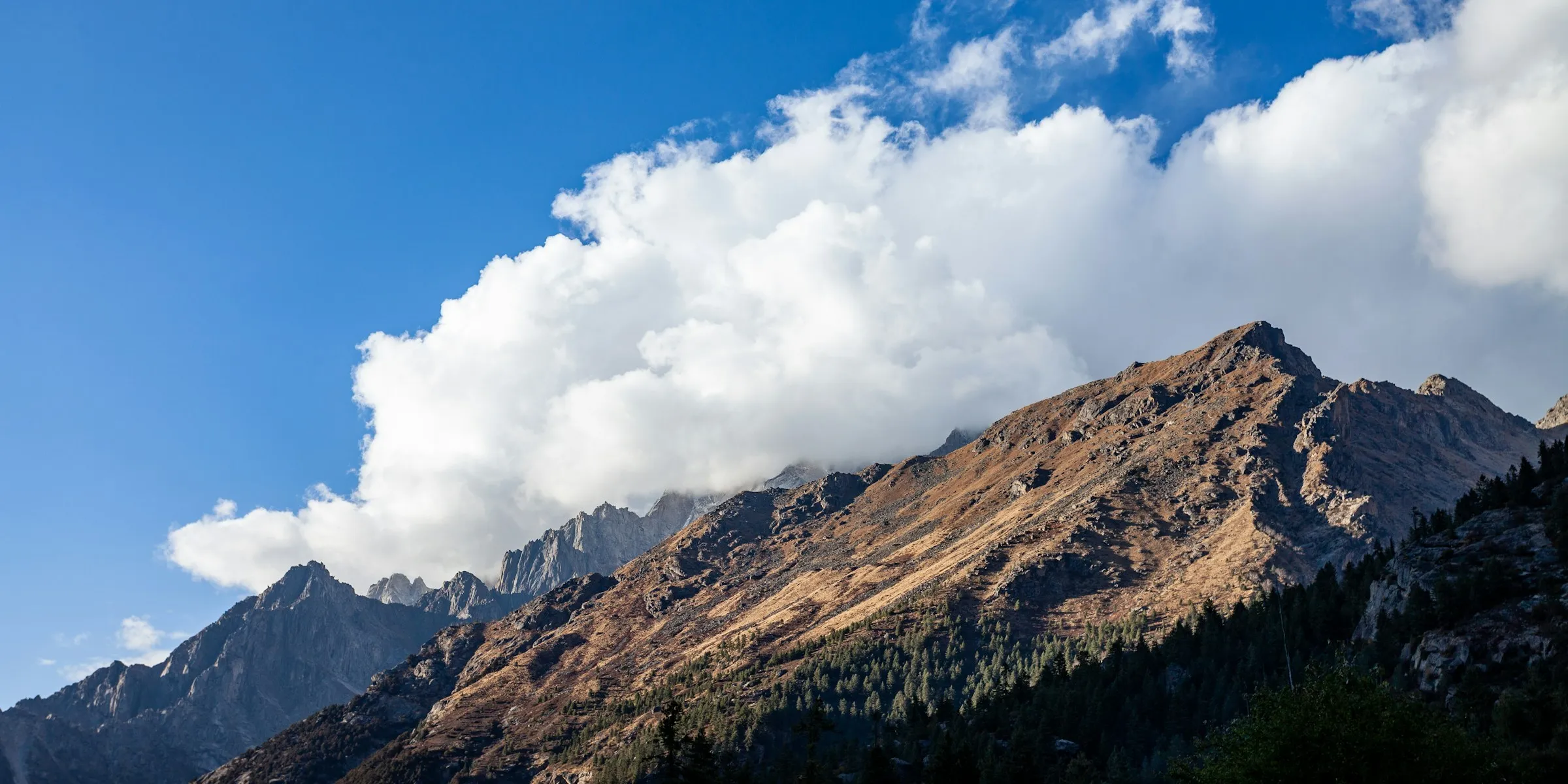
Chitkul, Himachal Pradesh Photograph: Chirayu Sharma / Unsplash
A warning that does not change what a family does that night is not a warning. It is a record.
This is the uncomfortable centre of risk intelligence in the Himalaya. The science has moved. Numerical weather prediction in India runs at resolutions that would have been research-grade a decade ago. Satellite coverage is close to continuous. Seismic and hydrological networks have thickened. On most measures of forecast skill, the country has closed ground on systems far better funded.
And yet the pattern of loss has not changed in the way that improvement should predict. People still die in places where a bulletin had already been issued. The gap is not in the forecast. It is in the hundred metres between the last official who received the message and the house at the bottom of the slope.
What “last mile” actually means on a slope
The phrase is borrowed from logistics, and it carries the wrong picture with it. In logistics the last mile is a delivery problem: the parcel exists, it simply has to travel further. In disaster risk it is a translation problem, and it fails in at least four distinct ways.
It fails as language. A bulletin that warns of 204.5 mm of rainfall in 24 hours is precise and almost useless to the person deciding whether to sleep in their house. Impact-based forecasting, which says what the rain will do rather than how much of it there will be, is now accepted doctrine. It is still unevenly practised.
It fails as geography. District-level warnings are issued for administrative units. Hazard does not respect them. In a state built out of valleys, two villages in the same block, eleven kilometres apart, can face entirely different risk from the same cloudburst. A warning calibrated to the district is either too loud for one of them or too quiet for the other, and people learn quickly which of the two it is.
It fails as trust. Every false alarm is withdrawn from an account. Communities that have evacuated three times for nothing do not evacuate the fourth time, and the fourth time is the one that matters. This is not irrationality. It is a reasonable response to a signal that has repeatedly been wrong, and it is a direct cost of treating warning as a broadcast rather than a relationship.
It fails as time of day. Cloudbursts in the Himalaya have an unkind habit of arriving at night. A dissemination chain that depends on someone being awake, reachable and in network coverage has a structural blind spot across exactly the hours when it is needed.
The part nobody budgets for
Early warning systems get funded as technology. Sensors, servers, dashboards, sirens. These are procurable, auditable, and they photograph well.
The last mile is none of those things. It is a volunteer in a village who knows which three households have someone who cannot walk out unaided. It is a schoolteacher who has run the drill often enough that children move without being told twice. It is a WhatsApp group that an actual named person maintains, in the local language, and that people have not muted.
None of this appears on an asset register. All of it decides whether the system works.
The Sendai Framework’s fourth priority, enhancing preparedness for effective response, is explicit that preparedness is a continuing investment rather than a procurement. In practice, the capital line is far easier to defend than the recurring one. A sensor network is bought once. The people who make it mean something have to be paid every year.
What traditional knowledge is actually for
There is a tendency to treat indigenous knowledge as heritage: respected in the preamble, absent from the method.
Treated seriously, it is a data source with properties that instruments do not have. It is long-baseline, covering periods before any gauge existed. It is spatially fine, resolving individual slopes and streams. And it is already trusted by the people who have to act on it, which is the single hardest property for any new system to acquire.
The point is not that local observation should replace a model. It is that a model which cannot be reconciled with what a village has watched happen for sixty years has a problem worth investigating, and that the reconciliation is usually where the useful finding is.
What we are asking at WSDM 2026
The Intelligence pillar at the summit is not framed around better sensing. It is framed around the question of what has to be true for a warning to end in an action.
Three things we want argued out in the room:
- What does last-mile success look like as a measurable target. Not messages sent, but households that moved, and how a district honestly measures that.
- Who owns the last mile. It sits between the meteorological agency, the state authority, the district administration and the panchayat, which in practice means it is nobody’s performance indicator.
- What a trusted channel costs to run for a year, per block, and whether any state has actually costed it.
These are not research questions. They are budgeting and accountability questions wearing a scientific hat, and the people who can answer them are administrators, not only scientists. That is why they belong in the same room.
Resilience starts at home. So does the failure, when the message never arrives.
The Intelligence pillar runs across all three days of WSDM 2026. Abstracts addressing last-mile warning, impact-based forecasting and community-based risk assessment are invited.
More from Insights
- Infrastructure Build for the slope, not the spreadsheet Himalayan infrastructure fails in a pattern. Almost always, the failure was priced out of the design long before the ground moved. Read
- Innovation A forecast is not an evacuation Prediction has become the easy half. The hard half is the chain of human decisions that has to fire before the water arrives. Read